Wednesday, January 5, 2011

003 Cow Cow Boogie


Title: Cow Cow Boogie
Studio: Walter Lantz
Date: 01/03/43 (BoxOffice may say this is actually January 4)
Credits:
Lyrics
Don Raye
Music
Gene de Paul
"Boogie Woogie" Piano ... Meade "Lux" Lewis
Directed by
Alex Lovy
Story
Ben Hardaway ... Milt Schaffer
Animation
Hal Mason
Musical Arrangement
Darrell Calker
Series: Swing Symphony
Running time (of viewed version): 6:41
Commercial DVD Availability: -

Synopsis: Cowboys like to stay at the ranch and sing Home on the Range, foreman utilizes passing piano player to round up the herd.


Comments: One of the two Lantz cartoons (out of 10 total) for the year which are not on official US DVD releases. Which is a bit odd as this was intended as a big enough short to have sheet music released for it (with Alex Lovy's name on the art; see below). Big lipped black caricature may explain the absence, or perhaps it's the scene when he's lassoed and abducted out of his clothes... Discouraging word: "itsgodagaininnit"? Udder cover that goes on the head; to avoid a bra joke? One bull shoots another in the face. The rushing cowpokes look weird and stilted; kinda floaty. Some of the cowhands retain the look of characters form '39 Lantz cartoons. And the cattle wave happily on the train to slaughter.

Meade "Lux" Lewis supposedly was the piano player in It's A Wonderful Life in Nick's Bar. The player in the short doesn't appear to be a caricature of him, as he seemed to be fat by this point, and had hair. Tho I suppose he might not be the singer... The character looks a bit like a grown up version of the form of Lil' Eightball that was still appearing in comics.

Monday, January 3, 2011

002 Jasper and the Choo Choo


Title: Jasper and the Choo Choo
Studio: George Pal
Date: 01/01/43
Credits: -
Series: Puppetoons (Madcap Models? Both terms appear in the retitle)
Running time (of viewed version): 7:21
Commercial DVD Availability: -

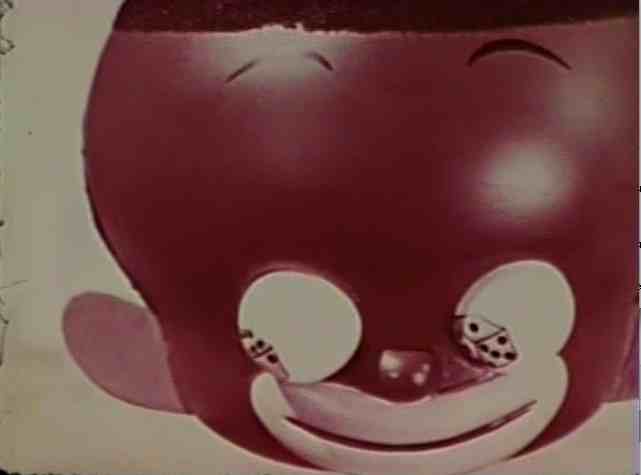
Synopsis: Jasper is tricked into a dice game by the scarecrow, and is saved by living dice.


Comments:

From a tv print so red, I can hardly believe it had any other colors. Considering every position was a different carved ad painted wooden puppet (no armatures, is my impression, unlike in later stop motion, and some earlier as well), you can forgive the extended shots of nothing that moves (a standard opening technique in cel animation) and cycled animation (again a a standard cel technique), but you still have to notice them. The scarecrow and the blackbird have unique designs, but then the Puppetoons tend to appear uniquely designed as there is so little contemporary material to compare them to. Thurl Ravenscroft like voice on the scarecrow (try to find actual voice). Scarecrow reverts to one of the standard locommdenom stereotypes tho; dice. Seven I win, other you lose. The running dice look great (to the strains of the William Tell Overture). Seems like a big influence on Oogie Boogie in Nightmare Before Christmas (voice, gambling, etc.). The flattened to unflattened puppets look good. End with Jasper learning a lesson that gambling never pays (similar to his mother's opening advice, "you don't get nothin' for nothin'"). The story isn't exactly consistent; halfway through, the understandable gambling/tricking Jasper story is replaced by the dice coming to life and throwing the characters into diceland, where there is in fact a train of black dice that chases them for awhile. But not enough to name the cartoon after it, I think. It's then a very Benny Hill affair, with super speed chasing (no voluptuous women tho), until the closing moral back home. There's a certain stiffness to many shots; things like the racing dice scene show the stiffness was not inevitable, but likely due to budget and time constraints. The dixieland jazz feels very different from other cartoons (Droopy's flea circus music is the obvious other option in brain).

--
A Note on studio identification -

While I am labeling the Puppetoons (Madcap Models) as being from the George Pal studio, it would also be fair to label them a from Paramount, as it would for Famous cartoons. This constitutes brutally uneven treatment of Leon Schlesinger, whose output has been classed as Warner Bros., and is likely just as unfair to any number of other independent producers whose work has been labeled under the banner of a larger studio. Such is the capricious nature of blogs.


Interesting closing logos page: http://www.closinglogos.com/page/George+Pal+Puppetoons

A Note on Including Puppetoons

Including the Puppetoons in a "cartoons" blog is not entirely clear cut. It comes down to a question of what constitutes a cartoon. Many people disagree that stop motion animation of this type is a "cartoon". Leonard Maltin's Of Mice and Magic, for example, does not include them in its filmography, when they constitute a big enough set of films in the right time period made in the right country to include; the implication was that Maltin does not (or did not at the time) consider them cartoons. Perhaps the simplest (most glib) justification that they are cartoons is that Paramount referred to Puppetoons as cartoons, seen in this ad in the December 25, 1943 BoxOffice:


The overall upshot is that I am including George Pal's Puppetoons in this blog, in the official count of shorts.

The following is the most fleshed out of my responses on the issue, from a GAC discussion thread (with a spelling correction of two here). The opening sentence makes more sense when read in context, where it is in response to Fibber Fox (Yowp) saying that "Cartoons are simply a form of drawing":

"Yes, a _form_ of drawing. (I would also say a _form_ of scuplture, or a _form_ of painting; I would not say a form of acting, but others might.) So in other words, in "Snow White", Dopey is a cartoon character, but Snow White isn't, because she is not that type of drawing. In "Gulliver's Travels", Gabby is a cartoon character, while Gulliver is not. The Incredibles in "The Incredibles" are cartoon characters, while no one in "The Polar Express" is. Jasper in "Jasper and the Choo Choo" is a cartoon character, while no stop motion character in a Tool video is. The Mad Hatter in Disney's "Alice in Wonderland" is a cartoon character, but the Mad Hatter as played by Edward Everett Horton in the 1933 live action "Alice in Wonderland" is not.

So there is then a question of: is a work a cartoon if it has no cartoon characters in it? I think it could be, but it would have other cartoon elements. Think of a late Tex Avery "Of Tomorrow" cartoon that doesn't have many characters, and could exist without any characters with a few different gags. It does have things drawn in an amusing way. But simply having something animated in drawings does not make a cartoon. I don't think UPA's Tell Tale Heart is a cartoon, as it has nothing amusing about its visuals.

So, does having any amusing drawings make something a cartoon? In other words, is "Snow White" a cartoon simply because it has Dopey and other amusing drawings in it? If so, then you need to class Last Action Hero and Mrs. Doubtfire as cartoons. My thinking is that there needs to be a certain amount of cartoons in a piece to make it a cartoon. That is of course extremely vague and ill defined. But I would say that Snow White has enough to qualify, and Last Action Hero does not.

So, to Fibber Fox's "comedy or drama makes no difference whether something is tv or not" point. This illustrates that the aspects of whether something is a comedy, drama, an amalgam of comedy and drama, or another parallel or overlapping category, are immaterial to whether something is a television show. Similarly, there are many things that are immaterial to whether something is a cartoon or not. But we do not all agree on what the defining characteristics of a cartoon are.

A group appears to have taken the following position (or something close to it; it is simplified as it is not my view): all drawn 2D animation pieces are cartoons, no animation that is not drawn 2D animation is a cartoon. This differs from my working definition, which is: hand created art (including sculpture and computer wire frames) which is abstracted into an amusing form and which is presented in a filmic way (generally but not necessarily animated) are cartoons; no filmic piece which does not use hand created visuals abstracted in an amusing way is a cartoon.

The definition of cartoon has varied over the years; I'm sure there were art historians objecting to when humorous black and white drawings were referred to as cartoons, when that violated the meaning they assigned to the word, meaning rough sketches for tapestries. And I'm sure people cringed when people referred to something like a Mickey Mouse film as a cartoon instead of as an animated cartoon, since actual cartoons could only be two dimensional drawings on paper. And even now, people in this forum object when humorously designed stop motion animation is referred to as a cartoon, although Paramount was doing so in 1943 (see ad at the bottom of this post). But the lexicon soldiers on, and while some people are truly sincere that "cartoon" should apply both only to what they think is a cartoon and should always be applied to all the animation they think is a cartoon because they think to do otherwise somehow demeans animation into only being humorous, such sincerity does not make their argument rational."


You can see some of the discussions of the issue at GAC:

http://forums.goldenagecartoons.com/showthread.php?t=15069


http://forums.goldenagecartoons.com/showthread.php?p=181122#post181122

Saturday, January 1, 2011

001 Der Fuehrer's Face


Title: Der Fuehrer's Face
Studio: Disney
Date: 01/01/43
Credits: (directed by Jack Kinney, song by Oliver Wallace)
Series: Donald Duck
Running time (of viewed version): 9:15 with Leonard, 7:56 without
Commercial DVD Availability: Chronological Donald volume 2, On the Front Lines (also a Donald volume?)

Synopsis: Donald Duck is a funny nazi, but it turns out to be a dream.


Comments: Disney abandoned this short to the "From the Vault" section of On the Front Lines. Especially egregious as it's the Academy Award winner for 1942 (how precisely this is to be accounted for is unclear to me; it is possible the date rules for the Academy Award were not the same then as now, or perhaps there was a token release of the cartoon before January 1 to qualify it; the cartoon seems to be solidly identified as a New Year's Day 1943 release). In addition to interrupting cartoon watching, forced introductions also taint the viewer's perceptions of a given cartoon, which is of course quite probably the point. There's some strange framing for some of the rank and file, cutting off the top of heads. Shadow shot. I wonder how much people reflected on the problems depicted as in Germany were also problems in the US (rationing, forced patriotism, working long hours for the war effort, etc.). And to what extent did people find it odd that Donald was a German, and a Nazi (until the eraser at the end)? The working in the munitions factory is more or less like "Lucy in the candy production line" skit. Crazy bombs look great. In shadow, the Statue of Liberty is the same as Hitler; bit of a dicey message. The dvd prevents you from skipping the intro, and screws up the audio if you skip around in a timeline as available on a computer dvd player. The song sounds very much like "It's a Small World", tho the songs do not share a composer. I wonder if celebrity caricature will be uniformly replaced with political caricature this year...

1943 Rising

Hello 1943, and how are you doing today?

1943 as a year has a different character than 1939; while you could hear the drums of war approaching in 1939, war itself did not come for America for nearly two more years. In 1943, the US had been at war for more than a year, and the so called sleeping giant had awoken. I expect this will come out in the cartoons; as I look at what is ahead of me, I see much from the Disney On the Front Lines set, and many more cartoons I know to be war based or that clearly are from their titles.

You may note that there are links to Amazon when a cartoon is on an in print (ish) DVD; if someone uses that link and then buys a copy of the DVD from Amazon (not a third party seller) form that page, I will, in theory, eventually benefit with credit to the extent of a small percentage of the sales price at Amazon. This note is not to encourage you to buy through the links as such, but to alert you that their inclusion isn't altruistic.